Matcha Tastes Bad at Home: The Real Reason and the Right Tools
Here’s the misconception that causes most people to give up on home matcha: they assume bitter, gritty results mean they bought low-quality powder. Usually, the powder is fine. The preparation is wrong.
Technique failures account for the majority of bad home matcha. And bad tools make good technique nearly impossible. Fix both — in that order — and the result changes completely. The product recommendation in this piece comes halfway through, and it earns its place on numbers and reviewer data, not on marketing copy.
Why Home Matcha Turns Out Bitter and Gritty
There are three specific failure points. Most beginners hit at least two without recognizing them, because the feedback loop is subtle — you just assume matcha tastes bad. Understanding what’s actually happening at a chemical and physical level makes the fix obvious.
Water Temperature: The Variable Most People Ignore
Matcha is a ground whole-leaf green tea with a precise amino acid profile. The compound most responsible for its characteristic sweetness and umami flavor is L-theanine. At boiling temperature — 212°F / 100°C — L-theanine degrades rapidly. What remains is the bitter, astringent catechin fraction. You’re effectively burning the desirable components while concentrating the harsh ones.
The correct brewing range is 160–175°F (70–80°C). That’s not a loose suggestion. The same powder brewed at 195°F versus 170°F produces a noticeably harsher cup — same technique, same amount, different temperature. A basic instant-read kitchen thermometer costs $10 and eliminates all guesswork. The high-end solution is the Fellow Stagg EKG kettle ($165) with programmable temperature settings. The zero-equipment fix: boil the water, let it sit for 3–4 minutes, then pour. Temperature typically falls to 175–185°F in that window — not perfect, but a dramatic improvement over boiling.
Many home matcha drinkers have only ever tasted their powder prepared with boiling water. If that’s you, you genuinely don’t know what the matcha tastes like yet.
Clumping: A Texture Problem That Sifting Solves Completely
Matcha powder is hygroscopic — it absorbs moisture from ambient air constantly. By the time a tin has been opened more than once, the powder has already begun to form microscopic clusters. Pour that directly into water and those clusters don’t dissolve; they break into smaller visible chunks. You end up with uneven flavor and a sandy, gritty mouthfeel that has nothing to do with the quality of what’s in the tin.
A fine-mesh sifter — 80 to 100 mesh — breaks these clusters before they contact liquid. The process takes ten seconds: tap the measured powder through the sifter into the bowl, then add water. Texture problem eliminated. This is a basic preparation step, not an advanced ritual refinement. Most matcha packaging skips mentioning it entirely, which is why so many people skip it.
If your matcha bowl has ever felt gritty at the bottom after drinking, sifting is the fix. It’s that direct.
Whisking: Why the Right Tool Changes Everything
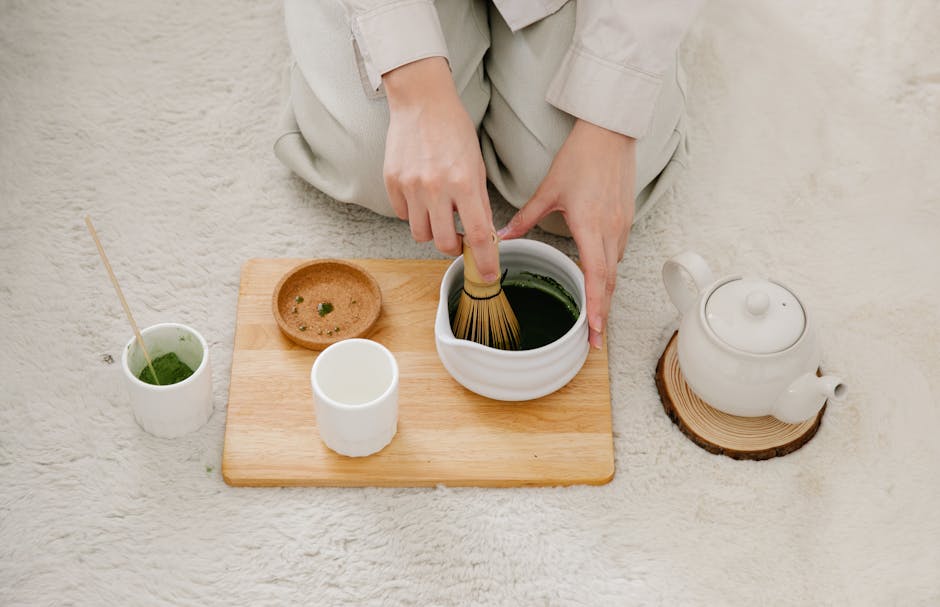
The correct motion for matcha whisking is a rapid, shallow W or M pattern across the surface of the liquid — not circular stirring, not slow folding. The goal is incorporating fine air bubbles to create stable foam. This takes 15–30 seconds of fast, deliberate motion with the right implement.
The traditional bamboo chasen is not ceremonial affectation. Its 80–100 thin, flexible tines create exactly the turbulence needed for fine foam formation. A metal kitchen whisk has rigid wires that trap large, coarse bubbles that collapse within seconds. A fork moves liquid without aerating it. The physical properties of bamboo — its flex, tine density, and spring — are specifically suited to this task in a way that metal and silicone alternatives are not.
After proper whisking, the surface should look like pale green sea foam: fine, uniform, stable. If it looks like liquid with bubbles collecting at the rim, the motion was too slow, too circular, or the tool was wrong.
The Six Tools a Real Matcha Setup Actually Requires
Marketing around matcha equipment inflates the complexity. Stripped back, you need six functional items. Here they are, with specific details worth knowing before you buy.
- Bamboo chasen (whisk) — 80-tine minimum for functional foam; 100-tine produces finer, more stable froth. The base binding should be tight and the tines springy under light pressure. Replace every 3–6 months with daily use, or sooner if tines begin to splay significantly.
- Chawan (matcha bowl) — Interior rim diameter of at least 4.5 inches. Narrower bowls physically restrict the whisk. Ceramic is the correct material. The weight and width of a well-made chawan also affects grip stability during whisking — something you notice immediately compared to using a random kitchen bowl.
- Fine-mesh sifter — 80+ mesh. Not optional. The texture difference between sifted and unsifted matcha is large enough that skipping it should be considered a preparation error, not a personal preference.
- Chashaku (bamboo scoop) — Holds approximately 1 gram of powder per scoop. Two scoops per 70ml water is the standard usucha (thin tea) ratio. Using a standardized scoop is what makes preparation repeatable without needing a scale every time.
- Chasen holder (kusenaoshi) — A dome-shaped rest that maintains the whisk tines in their correct curved shape between uses. Without one, tines splay outward within a week of daily use and whisking performance drops noticeably before they break. A basic holder costs $4–$8 and extends whisk life by a factor of three, at minimum.
- Powder storage jar — Matcha oxidizes under light, air exposure, and heat. An opaque, airtight container is the correct long-term storage. The original tin works short-term; a dedicated jar is better when decanting from a larger resealable bag.
What you don’t need: an electric milk frother. Functional for matcha lattes with steamed milk. Not appropriate for thin ceremonial preparation — the foam structure is fundamentally different and the result doesn’t taste the same.
Matcha powder is sold separately from every equipment kit — shelf life and FDA labeling make bundling impractical. For ceremonial-style preparation, Ippodo’s Ummon-no-mukashi (~$28 for 40g), Aiya’s Ceremonial Grade (~$22 for 30g), and Ujido’s ceremonial offerings are all reliable mid-range starting points. Avoid culinary-grade powder for this preparation style. It’s processed from older leaves, ground differently, and tastes significantly harsher when brewed thin without milk to mask it.
Set vs. Piecemeal: The Actual Cost Breakdown
Whether a pre-built kit makes financial sense depends entirely on how many tools you already own. Here is the real math, using current Amazon pricing for individual items purchased separately.
| Tool | Individual Amazon Cost | In TEANAGOO 12-Pc Kit? |
|---|---|---|
| Bamboo chasen (80-tine) | $12–$18 | Yes |
| Ceramic chawan | $15–$25 | Yes |
| Chasen holder | $4–$8 | Yes |
| Chashaku (bamboo scoop) | $5–$10 | Yes |
| Fine-mesh sifter | $8–$15 | Yes |
| Powder storage jar | $8–$15 | Yes |
| Two ceramic cups (7.2oz each) | $12–$20 | Yes |
| Faux leather storage case | $20–$35 | Yes |
| Total if bought separately | $84–$146 | — |
| Complete kit price | $49.28 | Everything above |
The set undercuts individual purchasing by $35 at the conservative low end and nearly $100 at the high end. The storage case alone would run $20–$35 purchased separately.
Bottom Line: If you need four or more of these items, the kit wins without a close comparison. The only financially rational reason to buy piecemeal is if you already own at least half the tools. This is not financial advice — but these numbers aren’t subtle.
The TEANAGOO 12-Piece Set: A Direct Assessment
For beginners and gift buyers, this is the right kit at this price point. Not because of packaging photography — because the components are complete, the quality holds up under scrutiny, and the price undercuts piecemeal buying by a margin that’s hard to argue with.
What the $49.28 Actually Gets You
The TEANAGOO 12-piece matcha whisk set includes a bamboo chasen, chasen holder, chashaku, ceramic chawan, fine-mesh sifter, powder storage jar, two 7.2oz ceramic cups, and a structured faux leather storage case with an inner display box. It also ships with an instruction manual covering ratios, water temperature, and whisking technique — a practical addition that most competing kits omit entirely.
The packaging is a genuine strength at this price tier. “The presentation and the packaging is so nice. Everything is well packaged in a stylish box and then you have a leather bag to put the box in,” one verified reviewer wrote. For gift purchases specifically, this matters — the box doesn’t require additional wrapping and presents well as-is. “It is gorgeous!!! The casing is soft faux leather. The storage case is like a display box. I LOVE IT!!” — that reaction comes up repeatedly across the 209 verified reviews.
Material quality is the other consistent theme. The ceramic components are solid and appropriately weighted, and multiple buyers noted quality exceeded their expectations for the price. Across a 4.8/5 average from 209 reviews, the quality-to-price ratio is the dominant praise — not a few outlier reviews inflating a mediocre average.
The One Complaint Worth Taking Seriously
The case. It’s the kit’s most visually impressive feature and its most honest limitation. It’s engineered for storage and display — not for commuter portability. One buyer put it directly: “I purchased this with intentions of using it for travel. It is too big.” The footprint is roughly that of a standard hardcover book with added depth. Car travel, checked luggage, a shelf, a desk — all fine. A small day bag or commuter backpack — not going to work comfortably.
If portability is the main requirement, the TEANAGOO 10-piece matcha kit at $45.99 uses a bamboo tray layout instead of a structured travel case. It’s rated 4.7/5 across 89 verified reviews, uses the same quality components, and sits with a smaller overall footprint suited to a fixed home setup. The trade-off: the presentation packaging is less impressive, which is a real consideration if this is a gift.
Who Should Skip Both Sets
Skip the kit if you already own a quality chasen and chawan. Spending $49 to acquire a sifter and scoop doesn’t hold up — buy those two items for under $15 combined. Also skip if you primarily make matcha lattes with steamed or frothed milk: a $15 electric frother does that job adequately, and the ceremonial tools in these kits are not where the value lies for that use case.
Questions That Actually Come Up About Matcha Equipment
Does it matter whether the chasen is hand-cut or machine-made?
For home use at this price point, less than specialty retailers suggest. Hand-cut chasens from Nara, Japan — where the traditional craft is centered — have more even tine distribution and fine-tuned flex characteristics. The price reflects it: $25–$50 for a quality hand-cut chasen versus $12–$18 for a standard machine-made version. For daily home preparation, a machine-made 80-tine chasen performs appropriately. The difference becomes meaningful at the level of formal tea ceremony where technique is being evaluated by someone who knows what they’re looking at — not at the level of morning home matcha.
How long does a bamboo chasen actually last with regular use?
With proper care — warm water rinse after each use, no soap, dried on a kusenaoshi holder — a standard 80-tine chasen lasts 2–4 months with daily preparation. Without the holder, tines splay and lose shape in 1–2 weeks, and whisking performance drops significantly before the tines actually break. The holder is not optional maintenance; it’s what makes the whisk last.
One gap worth knowing: a reviewer mentioned the only thing they’d improve is “to add a towel rest” for drying the chasen after rinsing. It’s not included in the TEANAGOO kit. A folded cloth or small silicone mat serves the purpose without any additional purchase.
Is ceremonial-grade matcha actually different enough to matter here?
Yes — and significantly so when preparing it thin, without milk or sweetener, the way this kit is designed for. Culinary-grade matcha uses older, more mature leaves from lower on the plant, dried and processed differently, with a flavor profile that skews bitter and grassy. Ceremonial grade uses young, shade-grown leaves from the top of the plant, processed to preserve chlorophyll and amino acids. The grade difference is partially masked in lattes. For thin preparation, it’s not masked at all.
Start with Ippodo or Aiya’s ceremonial offerings before spending more on ultra-premium options. Taste the difference first. Then decide whether the price gradient is worth it to you.
Home matcha preparation has been quietly closing the gap with specialty cafés for years. The tools are more accessible, the information is better, and the learning curve is shorter than the ceremony framing implies. Three variables — temperature, sifting, and whisking — control the majority of the outcome. Get those consistently right, and what comes out of a $49 kit is genuinely comparable to what a trained barista charges $9 for.